
Many HR directors hit a glass ceiling. All the processes seem to be in place, hiring is happening, salaries are being paid, but the CEO doesn't invite you to strategic meetings, and the board of directors sees you as nothing more than an administrator.
Why do some remain simply "chief HR officers," while others become CHROs (Chief Human Resources Officers) , earning millions of dollars annually and directly impacting the company's stock price? The answer lies not in the job title, but in a fundamental shift in mindset and role model.
In this article, we'll explore the differences between a CHRO and an HRD, what CEOs really expect from you, and how to use the Gartner competency model to take your career to the next level.
HRD vs CHRO: What's the Real Difference?
The first step to transformation is to honestly answer yourself about where you are now.
CHRO manages the company's future through people, just as the CFO manages the future through finance.
Why is the role changing now?
The business world has become VUCA (or BANI)—volatile and complex. A Deloitte study shows that the skill set for CHROs has grown by 23% over the past five years.
CEOs (60% of them) are rethinking the role of HR. They no longer need just a performer. They need a Business Executive—a business leader who understands the P&L (profit and loss statement), investments, and can argue reasonably with the CFO.
Gartner's World-Class CHRO Model
Becoming a world-class CHRO requires more than just a thorough understanding of labor laws or recruiting methods. Gartner has developed a model consisting of five key roles that a modern leader must master.
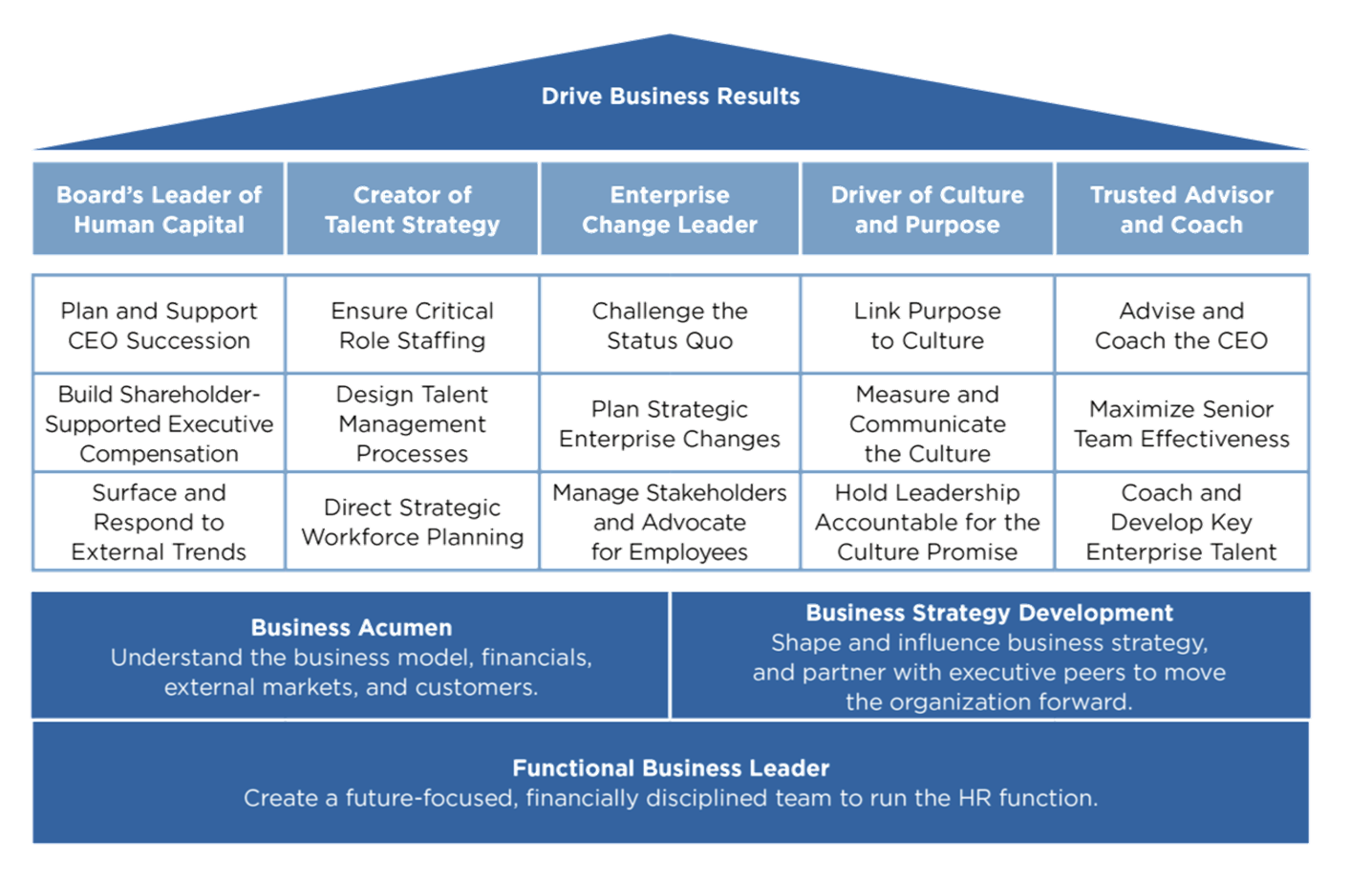
1. Board & CEO Leader of Human Capital
You're no longer just delivering turnover reports. You're setting the board's agenda.
- What to do: Prepare succession plans for the CEO and senior management team. Report on risks, ESG (environment, social, and governance), and culture.
- The result: the board of directors is confident in the sustainability of the business because it knows who will lead the company tomorrow if something happens to the CEO.
2. Creator of Talent Strategy
This isn't about "filling vacancies." It's about answering the question: "What kind of people do we need in three years to beat the competition?"
- What to do: Build a Leadership Pipeline, identify critical roles, and use predictive analytics to forecast needs.
- Result: the company always has the necessary talent to launch new products and expand.
3. Enterprise Change Leader
CHRO is the main driver of change.
- What to do: Implement changes using methodologies (e.g., Kotter's 8 Steps or ADCAR). Develop organizational agility and resilience.
- Result: the company quickly adapts to crises and market changes without falling apart.
4. Stakeholder Leader
The most difficult role is to be an equilibrist.
- What to do: balance the interests of four groups:
- CEO and Board of Directors (want profit and growth).
- Employees (want fairness and work-life balance).
- Investors (want ROI and reduced risks).
- Society and the state (want ethics and compliance with laws).
- The result: a harmony of interests, where a business win does not mean an employee loss.
5. Trusted Advisor and Coach
You are the only person who can tell the CEO the truth to his face (of course, politely and privately).
- What to do: Coach the CEO and the top team. Resolve conflicts at the C-Level. Be a mirror for the leader.
- The result: a healthy atmosphere at the top that spreads throughout the company.
🚩 Foundation: what holds everything together
These 5 roles are based on two fundamental blocks:
- Business Acumen: You must be able to read financial reports, understand the business model, know your competitors, and justify the HR budget using ROI. If you don't speak numbers, you won't be allowed at the negotiating table.
- Functional Excellence: Of course, you must be an HR expert. Build a strong team, automate routine tasks, and ensure flawless operations. This is the foundation without which you can't build a strategy.
Where CHRO candidates fail? (Top Mistakes)
- Poor understanding of finance. Unwillingness to understand how the company makes money.
- Focus solely on HR. When the board of directors discusses declining sales, the "bad" HR manager remains silent (after all, it's not about people), while the "good" CHRO proposes solutions (for example, revising sales incentives or training).
- Ignoring the outside world. Focusing on internal processes and ignoring investors, the market, and trends (ESG, AI).
The CHRO Formula of the Future
CHRO of the future = business strategist + cultural architect + technology leader.
Transitioning from HRD to CHRO is a challenging but rewarding journey. Start with an honest assessment of your competencies using the Gartner model. Ask yourself, "Which of these 5 roles am I already strong in, and where do I need to learn?"
👉🏻 CHRO Assessment Checklist - Google Sheets
The CHRO: Chief Human Resources Officer course is your opportunity to take your career to the next level. You'll gain a world-class CHRO model, learn to be a strategic partner to the CEO and board of directors, and become a leader who shapes the company's future.