

Many senior developers, tech leads, and system architects believe that the logical pinnacle of their careers is the CTO (Chief Technology Officer) position. However, in practice, moving up to the top management level often turns out to be disappointing for both the specialist and the business. Why? Because deep technical expertise is only the bare minimum for a CTO.
A true Chief Technology Officer isn't the smartest programmer in the room. They're a strategist who can translate business goals into technology and turn IT infrastructure into a company's primary competitive advantage.
In this article, we'll explore the evolution of the CTO role, how this position differs from other C-level positions, and the key competencies a technical specialist must develop for a successful career leap.
Role Evolution: From Lab Director to Business Strategist
Understanding the CTO function is impossible without historical context:
- After World War II, large corporations created separate research and development (R&D) labs. The director of such a lab was not involved in operational matters. His or her job was to hire scientists and oversee the long-term development of prototypes.
- Late 1980s: Computers became a mass-market business tool. Technology ceased to be just a "science" and became a factor directly impacting profits. Businesses needed someone capable of combining an understanding of innovation with commercial strategy. This is when the modern role of Chief Technology Officer was born.
- 2000s: The CTO was perceived more as the head of the IT service (chief of infrastructure and servers).
- The 2010s: The era of digital transformation and mobile apps. The CTO became the technical leader and chief product architect.
- 2020s and beyond: In the era of AI, Big Data, and machine learning, the CTO's focus has shifted decisively toward business strategy. Today, they are a full-fledged business partner to the CEO and a driver of digital transformation for the entire company.
What is the true mission of a CTO?
The CTO's primary goal is to transform technology into a source of competitive advantage and sustainable business growth.
If a company spends millions on microservices, but this doesn't speed up time-to-market or generate additional revenue, the technology is wasted. The modern CTO's principle is: "Technology works for the business, not for the sake of technology."
Key aspects of the mission:
💎Ensure technological superiority and business resilience.
💎Link business goals with technological capabilities.
💎Create innovations that increase product value and process efficiency.
💎Develop a culture of engineering leadership and continuous improvement.
💎Maintain a balance between innovation and system stability.
Place in the structure
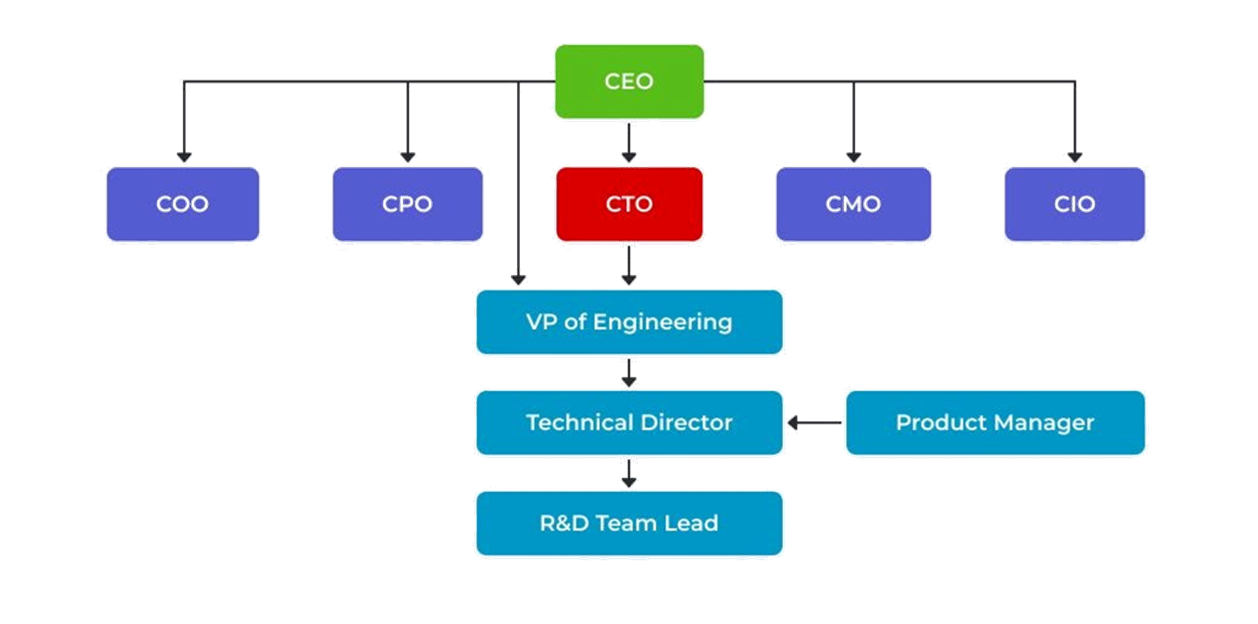
Anatomy of Top Management: CTO vs. CIO vs. CPO vs. VP of Engineering
There's a lot of confusion about job titles in the IT industry. Understanding your responsibilities is the first step to meaningful career growth.
1. CTO vs CIO (Chief Information Officer)
- The CTO looks outward. Their focus is on the product, external customers, innovation, and market capture through technology. They create the technologies on which the business is built.
- The CIO looks inward. Their focus is on the company's internal IT infrastructure, ERP/CRM systems, employee data security, and cost optimization. They manage the technologies that power the business.
- (If a company does not have a CIO, the CTO takes over his functions, and vice versa).
2. CTO vs CPO (Chief Product Officer)
- The CPO answers the question, "What are we building and why?" They study the market, user pain points, and are responsible for business metrics (retention, LTV, satisfaction).
- The CTO answers the question, "How do we implement this technically?" Their responsibilities include reliability, scalability, and architecture.
- (The point of their intersection is the joint formation of the Product Roadmap).
3. CTO vs. VP of Engineering
The most common misconception is to consider these roles as synonyms.
- The CTO is a visionary. They think 1-3 years ahead. Their job is to choose the right stack, architecture, and technology vector.
- A VP of Engineering is an operations manager (integrator). They manage people (engineers, QA, DevOps), processes (sprints, Agile), and are responsible for delivery (timely releases) in the here and now.
- (The ideal combination is for the CTO to set the course and the VP of Engineering to ensure the ship moves smoothly along that course.)
The CTO's Golden Ratio: A Balance of Innovation and Stability
The biggest dilemma for any CTO is how to implement cutting-edge technology without disrupting what's already making money for the company.
To solve this problem, top CTOs (for example, at companies like Amazon or Netflix) use several approaches:
✔ The 70/20/10 Rule:
- 70% of resources are spent on support, stability and optimization of the current system.
- 20% — for system improvements (refactoring, closing technical debt).
- 10% is allocated to pure innovation and bold experiments.
✔ Dual-Track IT: Separating a stable operational core (which cannot be touched) from an experimental "sandbox" where hypotheses can be quickly tested without risking the collapse of the entire business.
✔ Strict sustainability metrics: When implementing innovations, the CTO is required to monitor MTTR (Mean Time to Recovery), Uptime, and the number of incidents per release.
Competencies: What developers lack
A typical mistake a new CTO makes is to continue "coding by hand" and work for a senior developer or team lead. To become an effective CTO, you need to shift your focus to the following areas:
- Strategic thinking. Ability to think not in the language of frameworks, but in terms of ROI (return on investment), NPV (net present value), and time-to-value. You should be able to defend the budget to the Board of Directors, explaining how the transition to a new architecture will reduce operating costs by 15% next year.
- A broad technological perspective (not depth). A CTO isn't required to write the best Python code in the company. They should understand when to use a monolith and when to use microservices; how to implement a Cloud Native approach; how Data & AI ecosystems and CI/CD pipelines work.
- Leadership and engineering culture. You don't just create products; you build teams that create products. Emotional intelligence, the ability to delegate, and the ability to hire stronger people are critical skills.
- Financial literacy. Ability to manage IT budgets, estimate infrastructure cost of ownership (TCO), and optimize cloud computing costs.
Your First 100 Days as a CTO: An Action Plan
Consulting firm Roland Berger offers a clear framework for the first three months of a CTO position:
- Stage 1: Audit the current strategy and create transparency. Understand where the business is losing money due to technology.
- Stage 2: Setting up qualified reporting and technical KPIs that are understandable to the business.
- Stage 3: Team audit. Developing engineering culture, identifying "stars" and "bottlenecks" among the team.
- Stage 4: Rebuilding the development structure and processes to meet new business challenges.
The Chief Technology Officer position is a transition from a world dominated by compilers and algorithms to one dominated by people, budgets, and business strategy. A successful CTO combines three subpersonalities: engineer (understanding architecture), leader (inspiring the team), and businessman (speaking the language of money). If you're ready to move beyond the IDE and take responsibility for the growth of the entire company, this career path is for you.
Many engineers dream of becoming a CTO, but they face a major challenge:
👉 It involves little code and technology, but a lot of strategy, leadership, and decisions that impact the entire company . The Chief Technology Officer course is designed for those who want to take this step.
✅ Over 6 lessons, you'll see how a CTO thinks, what they focus on, the mistakes newcomers make, and the practices used by world-class leaders.
✅ After completing the course, you'll have more than just a set of knowledge—you'll have an action plan to take you to the next level:
- from engineer → to strategist,
- from team lead → to business leader,
- from "I do" → to "I manage change".