
Human resource planning (HRP) describes an ongoing, data-driven process in which a company systematically plans for the future in terms of human resources to ensure that available jobs are suited with appropriately skilled employees. It identifies key HR initiatives for the time period ahead that will help the organization achieve its strategic goals and maintain its competitive advantage without staffing shortages or excesses.
5 steps in the human resource planning process
The actual process of human resource planning involves five general phases. Listed below is a summary of each step to help you navigate the process:
1. Analyze organizational objectives and plans
Success in HR planning relies on its connection to business goals, so you must start with a final purpose in mind. Determine what the organization wants to achieve in the future, how it intends to accomplish this, and how HR efforts will contribute to it.
Each department will have unique objectives that HR will need to be involved in. Ideally, HR works very closely with management and has a clear grasp of what every area of the company is aiming for. Once you know that, you can ascertain how HR will meet those needs. For example, some departments may need you to focus on recruiting, while others may need to be downsized and reassign some current employees.
2. Evaluate the current state of your workforce and uncover gaps
Before you go forward with plans for the future, you need to assess where the organization’s workforce currently stands by assessing its strengths and weaknesses. Do you have the right number of experienced employees? Which skills at what levels do you already have on board with your existing staff? To do this, you should consider the following:
- What is your total number of employees?
- How many employees are in each department?
- How many employees hold each position?
- What are the education, skills, competencies, and qualifications of your employees?
- How do employees rank in the performance evaluation data?
- What are the ages of your employees? (How many are approaching retirement?)
There are several ways HR professionals can investigate these variables, such as:
- Meet with managers and department heads for their judgment of their employees’ abilities and where there is room for improvement.
- Conduct employee self-evaluations.
- Analyze HRIS data.
- Look at past performance reviews.
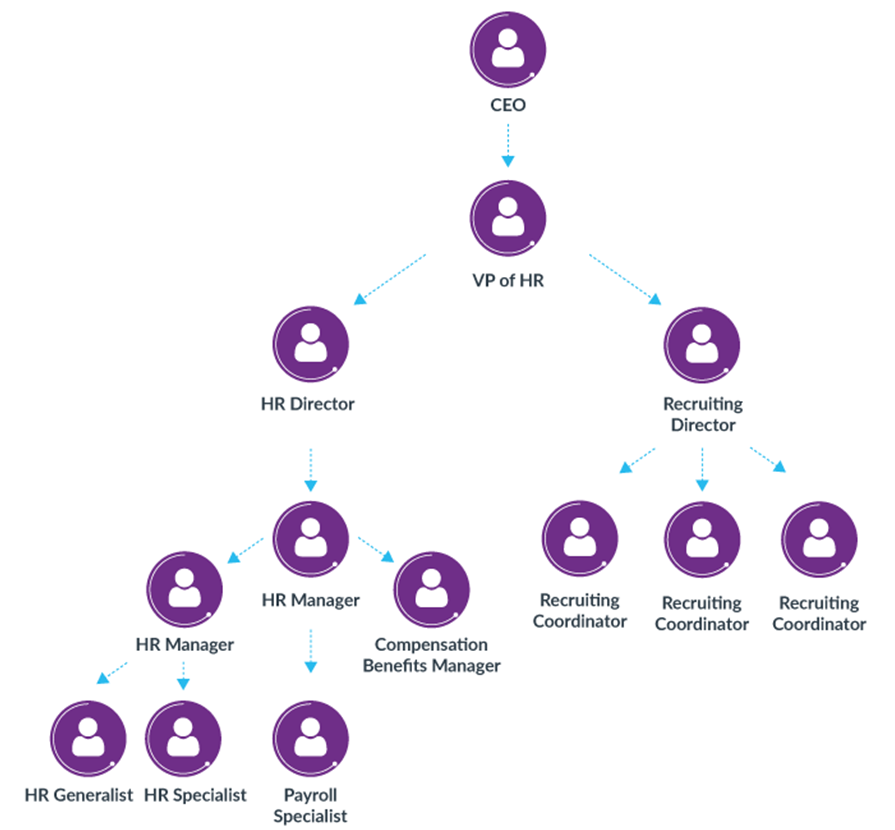
There are tools that can help you make a road map for this step of the HR planning process. An organizational chart is a visual description of a company’s staff structure that designates roles and reporting relationships. Below you can see an example of an HR organization chart in a mid-sized organization:
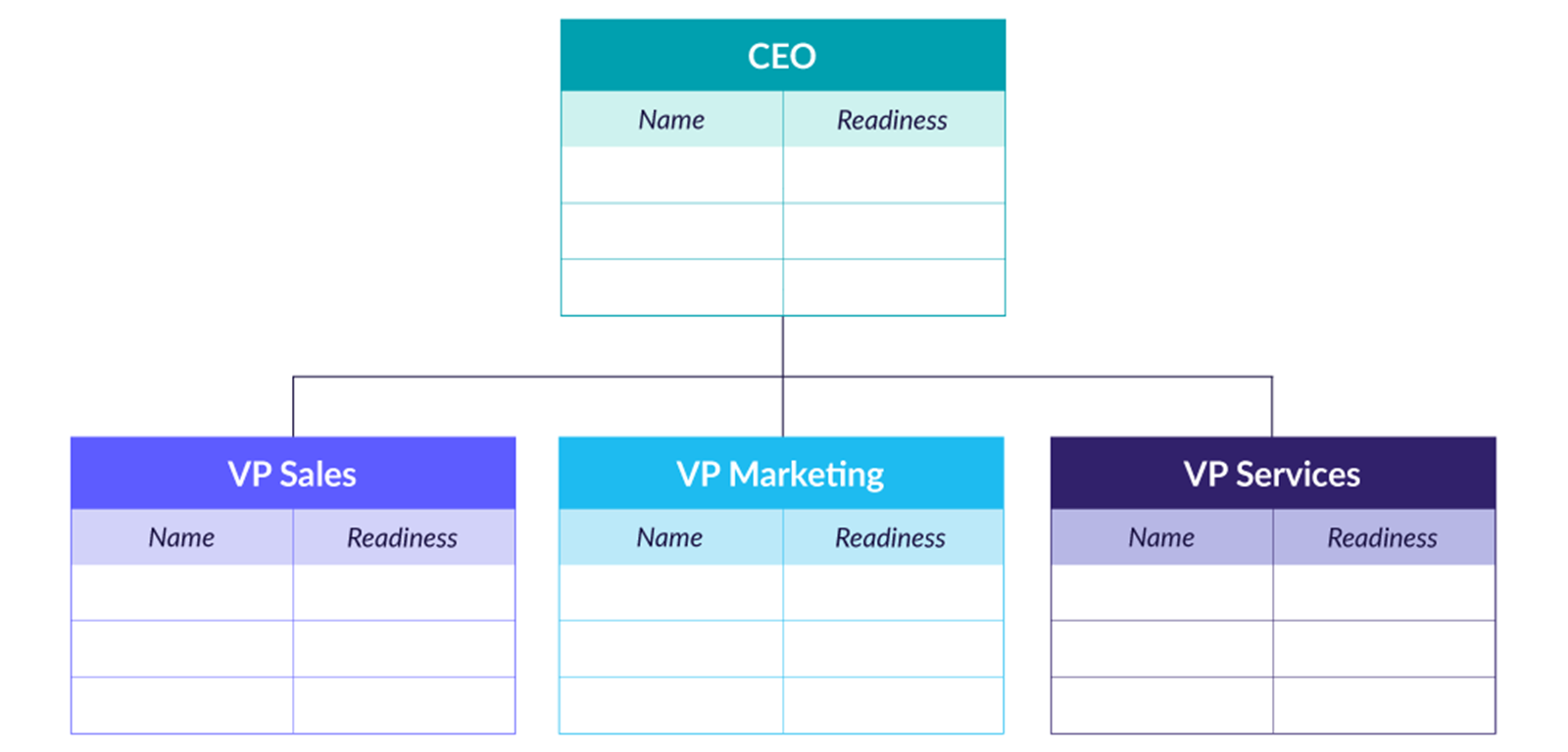
A replacement chart is a diagram of potential candidates and their readiness to step into certain roles upon employee departures.
3. Forecast future HR requirements
Forecasting demand is the critical stage of the HR planning process. Bearing in mind the organization’s future goals, gauge the coming demand and supply of qualified employees. Demand forecasting involves determining the number of people needed and the level of talent required. Supply forecasting estimates future internal (promotion, transfers, position expansion) and external sources and their ability to meet your needs.
You accomplish this forecasting using internal data and market and industry trends. Be sure to include factors such as these:
- New products or services on the horizon
- Prospective mergers or acquisitions
- Labor costs
- Projected employee retirements/vacancies and turnover rates
- Technological advances and automation
A gap analysis allows you to compare current employee quantity and skill levels with what will be needed to meet the organization’s goals. This method involves:
You can use a SWOT (strengths, weaknesses, opportunities, threats) analysis to compile your findings and see which elements need the most focus.
- Recognizing the current workforce status.
- Ascertaining what the ideal situation looks like.
- Identifying where the current lapses exist.
You can use a SWOT (strengths, weaknesses, opportunities, threats) analysis to compile your findings and see which elements need the most focus.
Then your job is to find out how you can match the demand for quality employees with the available internal and external supply by addressing questions like these:
- Do we need to add more employees for new roles? If so, where from? How many? Full-time or part-time?
- Does the market have an adequate supply of potential employees?
- Do we need to train and develop our existing employees for reallocation? Which ones?
- Are we drawing on the expertise of current employees sufficiently?
- Do we need to adapt any of our HR policies or practices to accommodate future human resources needs?
4. Develop and implement a plan
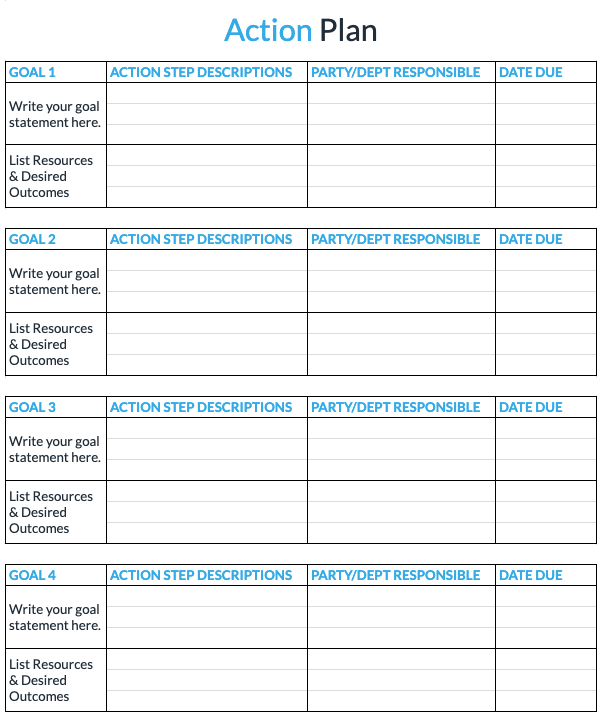
Now it’s time to formulate a human resource action plan that aligns with your organization’s overall strategy. It should take into account all the analyses you’ve completed and include talent strategies to match the supply and demand to get your organization ready for the future.
Your plan can start with the theoretical concept of transforming the company from X to Y and then name the step-by-step approach that HR will facilitate. This will include developing methods to enhance specific strategies to take you to the ideal stage. Typical areas of focus include recruiting, onboarding, training, benefits, performance management, remote/flexible work options, and company culture.
Here is a template of what an action plan could look like:
There is no one-size-fits-all content for a strategic HR plan. Each organization’s strategy will be unique, depending on its goals and the type of business it is. A small startup’s plan would include completely different factors than that of a multi-national corporation. One company may need to start with an enhanced recruitment program to find a certain number of highly skilled employees with specialized knowledge. Another company might be able to begin with training its current staff.
5. Monitor, review, and reassess your plan
After you put your human resource plan in place, you must determine whether it is yielding results. Review how well it is helping you execute the organizational strategy and achieve goals in areas such as productivity or employee retention and satisfaction, etc. Monitor the new practices and look for areas where the plan might be hindered.
It’s also essential to learn how changes are affecting employees. Managers can ask for feedback during performance reviews, or you can conduct employee surveys to get a feel for how things are going.
Once you have input, you can identify any obstacles and work around them to adjust and improve your planning. You can even return to step one and start the planning process again armed with what you learned from the initial implementation.
Human resources planning processes need to be an ongoing activity that is constantly evaluating and developing to stay in sync with all the changes companies must face.
Planning for the future is always a challenge when there is no way to be certain of what it holds, and you can’t foresee every possible development.
Get trained on the course 👉🏻 Staff rationing and optimisation аnd you can avoid having to improvise spontaneously in many situations.
With an accurate understanding of the dimensions and dynamics of human resources, you have the essentials for an effective human resource planning process that results in a concrete, actionable plan.