
Human resources are often viewed as a support function that fills recruitment requests and hosts company events. In reality, when HR becomes a system, it transforms into a powerful tool for generating business results
What Is an Effective HR System and Why You Need It
An HR system is not just personnel records. It is a set of interconnected processes, policies, tools, and a qualified team that attracts, develops, retains, and leverages human capital to achieve business goals.
Companies without a systematic HR approach suffer enormous losses:
Research shows specific business impact:
Companies without a systematic HR approach suffer enormous losses:
- Cost to hire one employee averages $4,000 — without a system, it increases due to wasted time
- Cost of termination is at least 33% of the employee's annual salary
- People lose up to 40% productivity when there is no clear management system
- ROI on investments is twice as high in companies with a developed HR system
Research shows specific business impact:
- Revenue of a company with strong HR function grows three times faster than without it
- Profitability is 21% higher with high employee engagement
- Turnover decreases by 40% with proper onboarding
- Retention improves by 20% through analytics and data
12 Key HR Functions in the System
A modern effective HR system consists of 12 key functions that work interconnectedly rather than in isolation:
1.Administrative function — record keeping, documentation, regulatory compliance
2.HR planning — forecasting employee needs
3.Recruitment — sourcing, attracting, and selecting talent
4.Performance management — results assessment, goal setting
5.Training and development — competency improvement
6.Career planning — employee development pathways
7.Employee assessment — competency and potential analysis
8.Compensation and benefits — salary, bonuses, benefits
9.Relationship management — communication, customer focus
10.Communications — information sharing, feedback
11.Health, safety, and wellness — physical and psychological well-being
12.Operating model and governance — structure and management of the HR function itself
HR Value Chain: How HR Makes Money for Your Company
Key idea: HR is not just support, it's a source of business results. It works like a chain:
`` BUSINESS STRATEGY ↓ HR STRATEGY ↓ HR PRACTICES ↓ HR OUTCOMES ↓ EMPLOYEE OUTCOMES ↓ BUSINESS RESULTS ``
Key principle: each level doesn't exist separately. Everything is connected. Without alignment with business strategy, the HR system loses meaning.
`` BUSINESS STRATEGY ↓ HR STRATEGY ↓ HR PRACTICES ↓ HR OUTCOMES ↓ EMPLOYEE OUTCOMES ↓ BUSINESS RESULTS ``
Key principle: each level doesn't exist separately. Everything is connected. Without alignment with business strategy, the HR system loses meaning.
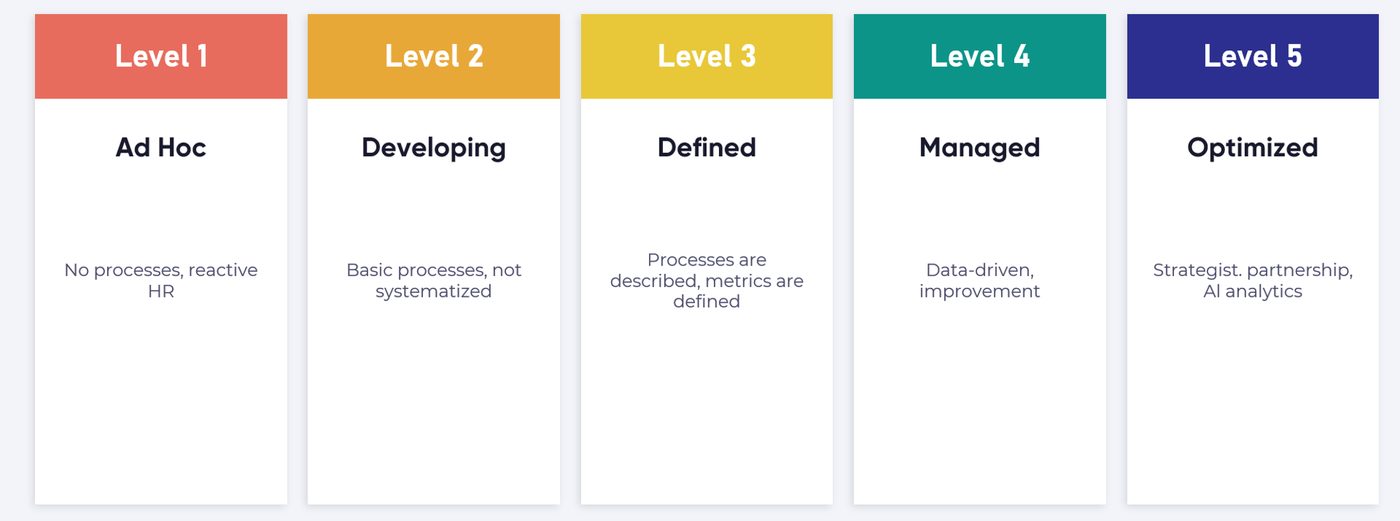
5 Levels of HR System Maturity
How to Build an HR System from Scratch: 10 Steps
If you're entering a company with no system, follow this path:
Steps 1–2: Understanding and Diagnosis
Business goals. Clearly study the company's 1–3 year strategy:
HR audit. Assess current state across 12 areas:
The audit shows your current maturity level and gaps between what you have and what you need.
Step 3: Choose Your Target Operating Model
There are several models for how an HR team is structured:
1. Functional model (for small companies)
2. Ulrich model (for growing companies)
HR performs 4 roles:
3. Three-legged business partner model (500–5,000 employees)
4. Mercer model (Agile HR) (5,000+ employees)
5. Gartner model (HR of the Future)
How to choose? Consider size (100 vs. 5,000 people), maturity (startup vs. mature company), role and responsibility, and align with CEO.
Step 4: Design Your HR Organizational Structure
Basic ratio: 1 HR professional per 80 employees (in tech companies — 1 per 35).
Consider:
Step 5: Document HR Processes
Start with the critical ones:
1.Recruitment — from job opening to employee start
2.Onboarding — first 90 days
3.Performance management — goal setting, assessment
4.Offboarding — employee departure
5.Then the rest: training, development, compensation
For each process, document:
Step 6: Implement an HR System (HRIS)
Automation isn't necessary, but it:
Choose by size:
When evaluating, assess:
Step 7: Define Key Metrics (KPIs)
Add your own KPIs based on strategy.
Step 8: Launch Communications
HR system only works if people know about it:
Step 9: Build a Management System
HR system depends 70% on how leaders use it:
Without this, beautiful processes stay on paper.
Step 10: Create a Support Network
HR system works through people ambassadors:
Steps 1–2: Understanding and Diagnosis
Business goals. Clearly study the company's 1–3 year strategy:
- How much is the company growing in size?
- What's the HR budget?
- What pain points do leaders have?
- How do business goals translate into HR tasks?
HR audit. Assess current state across 12 areas:
- Business alignment
- HR team quality
- Process existence
- Corporate culture
- HR outcomes (hiring, retention, engagement)
- Employee outcomes (productivity)
- Business results
- EVP (value to employee)
- HR technology
- Management practices
- Remote work readiness
The audit shows your current maturity level and gaps between what you have and what you need.
Step 3: Choose Your Target Operating Model
There are several models for how an HR team is structured:
1. Functional model (for small companies)
- HR divided by functions: recruitment, payroll, training
- Pros: simple, clear roles, inexpensive
- Cons: no strategic focus, scaling challenges
2. Ulrich model (for growing companies)
HR performs 4 roles:
- Strategic partner — HR strategy and business influence
- Change agent — transformation and innovation
- Administrative expert — processes and operational excellence
- Employee advocate — engagement and development
3. Three-legged business partner model (500–5,000 employees)
- HR leadership — strategy and management
- HR business partners — interaction with business functions
- HR Shared Services — routine operations
- Centers of expertise — developing new programs
4. Mercer model (Agile HR) (5,000+ employees)
- Focus on employee experience + technology
- People Operations & Advisory — key tasks
- Agile Pool — functional teams for innovation
5. Gartner model (HR of the Future)
- Separation of operations from strategy
- HR Chief Operating Officer — all routine work
- Strategic Talent Leaders — strategy and talent
How to choose? Consider size (100 vs. 5,000 people), maturity (startup vs. mature company), role and responsibility, and align with CEO.
Step 4: Design Your HR Organizational Structure
Basic ratio: 1 HR professional per 80 employees (in tech companies — 1 per 35).
Consider:
- Company size
- Needed roles (recruiter, coach, analyst)
- Budget
- Phased expansion (don't hire everyone at once)
Step 5: Document HR Processes
Start with the critical ones:
1.Recruitment — from job opening to employee start
2.Onboarding — first 90 days
3.Performance management — goal setting, assessment
4.Offboarding — employee departure
5.Then the rest: training, development, compensation
For each process, document:
- Inputs and outputs
- Responsible parties
- Tools and systems
- Success metrics
Step 6: Implement an HR System (HRIS)
Automation isn't necessary, but it:
- Speeds up processes
- Creates a unified database
- Foundation for AI and analytics
- Improves employee experience
Choose by size:
- Small companies: People Force (inexpensive)
- Mid-size: Bamboo HR, High Bob
- Large: Workday, Success Factors
When evaluating, assess:
- Functionality (do you have everything you need?)
- Scalability (will it grow with you?)
- Integration (with other systems?)
- Localization (in your language?)
- Total Cost of Ownership (all costs)
- User experience (is it convenient?)
Step 7: Define Key Metrics (KPIs)
- HR-to-Employee Ratio
- eNPS and engagement
- Time-to-hire, cost-per-hire
- ROI HR initiative
Add your own KPIs based on strategy.
Step 8: Launch Communications
HR system only works if people know about it:
- Town Halls — monthly all-company meetings
- Regular channels — Slack, email, bulletin board
- Feedback mechanisms — anonymous surveys, pulse surveys
- Question channels — where people can ask
Step 9: Build a Management System
HR system depends 70% on how leaders use it:
- One-on-ones — weekly meetings between manager and each employee
- Feedback system — 360-degree reviews, skip-level meetings
- Coaching skills — train leaders to listen and develop people
- Manager assessment — how do they manage people?
Without this, beautiful processes stay on paper.
Step 10: Create a Support Network
HR system works through people ambassadors:
- HR community — meetings, discussions
- Mentors and coaches — experienced employees help newcomers
- Conferences and development — internal and external
- Supportive culture — people help each other
📋 HR Audit Checklist
Use this checklist to assess current state (5 = excellent, 1 = poor):
[ ] Business alignment: Your HR strategy reflects business strategy
[ ] HR team: You have needed roles and competencies
[ ] Recruitment: There is a process, timelines are acceptable
[ ] Onboarding: Checklist, mentor, adaptation
[ ] Assessment: Goal system, regular feedback
[ ] Training: Development plan, courses
[ ] Compensation: Transparent salary system
[ ] Culture: Values, traditions, atmosphere
[ ] Engagement: People are satisfied, low turnover
[ ] Technology: You have HRIS or portal
[ ] Metrics: KPIs are tracked, there is a dashboard
[ ] Management: Leaders are trained, provide feedback
If most items are below 3, start here. If 3–4, develop. If 5, maintain.
Mistakes to Avoid
1.Build the process and forget about it
2.Don't link HR to strategy
3.Expect HR system to execute itself
4.Try to implement everything at once
5.Ignore metrics
- Many companies describe onboarding but then don't execute it
- Solution: Weekly checklist for each month (200+ items) of what to do
- Remember: HR system is like a living organism that needs maintenance
2.Don't link HR to strategy
- If HR doesn't know what business is trying to achieve, it works in a vacuum
- Solution: Always start with strategy, not processes
3.Expect HR system to execute itself
- Managers are the key. If they're not engaged, nothing works
- Solution: Invest in manager training, give them authority
4.Try to implement everything at once
- Companies try to implement all 12 functions in the first year
- Solution: 20% of processes first will give 80% of results. Stop, perfect, then expand
5.Ignore metrics
- Without data, you don't know if the system works
- Solution: Define 5 KPIs and track monthly
📋 Practical Checklist for First 30 Days
If you're a new HR director:
Week 1–2:
[ ] Interview CEO (strategy, pain points, expectations)
[ ] Meet with top management
[ ] Assess current HR state (people, processes, systems)
[ ] Understand headcount and structure
Week 3–4:
[ ] Conduct HR audit (anonymous employee survey)
[ ] Document current processes
[ ] Create list of gaps
[ ] Propose plan for first 6 months
🛠 AI Tools for Building HR System
Modern tools can help:
Use prompts like:
- Assistance with policy writing
- Analysis of HR data
- Strategy recommendations
Use prompts like:
- "Write a training and development policy for a 100-person company"
- "What questions should be included in an engagement survey?"
- "How do I define KPIs for an HR system?"
Remember: HR system doesn't start perfect. It grows. From level 1 (ad-hoc) to level 5 (continuous optimization) is a 5+ year journey. But each step brings real business value. Start today with the HR Formula course: The Complete Guide to Human Resources Management.
✅ Get all ready-to-use HR tools for personnel management. You'll only need to implement them in your company with the course author's support.
✅ You will go through the entire process of building company operations from A to Z.